 Atlanta Pro Network

When it comes to SEO vs paid ads for contractors, the honest answer is that it's a sequencing question, not an either/or. Ads are the fast lever: in our experience, Google and Meta ads can book jobs in the first one to two weeks. SEO and your Google Business Profile are the slow lever that compounds over months. Most contractors need both. What changes is which one you fund first, and that depends on how full your calendar is right now.
TL;DR
- Empty days on the calendar? Fund ads first. They can book jobs in the first one to two weeks.
- Calendar covered for now? Fund SEO and your Google Business Profile first. They compound over months.
- Before either, make sure missed calls get a text back and past customers hear from you. That's the fastest traction of all.
- Judge both by booked jobs, not clicks or rankings.
SEO vs paid ads for contractors: the short answer
| Channel | How fast it can produce calls | Best for | Main drawback |
|---|---|---|---|
| Reviews, reactivation, missed-call text-back | Early traction | Squeezing more jobs out of calls and customers you already have | Limited by the size of your customer list |
| Google ads | Can book jobs in the first one to two weeks | Homeowners actively searching for your service right now | You pay for every click, booked or not |
| Meta ads | Can book jobs in the first one to two weeks | Projects people plan: remodels, pools, outdoor living, inspections | Reaches people who weren't searching, so the offer has to be clear |
| SEO and Google Business Profile | Some improvements in weeks; ranking #1 in a competitive market can take a few months | Calls you don't pay for per click, building over time | No guaranteed position or date |
Before you fund either: fix the catch
There's a step most contractors skip. If calls go to voicemail while your crew is on a roof in Marietta, and nobody follows up on last month's estimates, more traffic just means more missed jobs.
The fastest wins usually hide here, and none need new traffic:
- Missed-call text-back. When you can't answer, the caller gets a text right away, so they don't just dial the next company on the list.
- Speed-to-lead automations. New form leads get a reply in minutes, not the next morning.
- Review requests. Every finished job gets asked for a review, which helps both your map pack visibility and the next homeowner's decision.
- Reactivation. Past customers hear from you about maintenance, another service, or a referral. They already trust you.
You still take the call and sell the job, but the system that catches leads and follows up can be built. We build it through our reviews and reactivation work, and it makes every ad and SEO dollar after it work harder.
Fund ads first when the calendar has gaps
Paid ads are the first move when you need work on the schedule now and you can handle the calls. That's the honest strength of ads: speed and control. You choose the service, the area and the page people land on.
Google ads vs Meta ads
They do different jobs, which is why we run them as a pair on our Google and Meta ads program.
- Google ads catch people already searching. A burst pipe in Decatur, an AC that quits during a Georgia July, a roof leak after a spring hailstorm. The homeowner is looking for someone today.
- Meta ads reach homeowners on Facebook and Instagram who aren't searching yet but are open to a project: a kitchen remodel in Brookhaven, a pool in Milton, a new patio in East Cobb, a free roof inspection after a storm. They work best with strong photos and video of your real jobs.
What earns an ad budget
- A defined job. You know which service you want more of.
- A defined area. You know where sending a crew makes sense.
- A matching landing page. The page talks about that service, in that area, with an easy way to call.
- A way to catch every call. Someone answers, or the missed-call text-back does.
- A booking record. You can tell which calls became estimates and which became jobs.
The drawback: you pay for clicks, not jobs. Keep the campaign accountable to booked work, and check the actual search terms. A search for roofing jobs or DIY repair parts isn't a customer.
Fund SEO first when today's work is covered
SEO and your Google Business Profile deserve the first budget when your schedule is fine for now and being found locally is the bigger weakness. This is the work that keeps paying off without a per-click bill.
Start with the pages and profile that help someone hire you:
- A service page for each service you want to sell, saying where you work and how to get an estimate.
- Service-area content for the towns you actually want: Alpharetta, Johns Creek, Sandy Springs, Roswell.
- A Google Business Profile with the right categories, real job photos, current hours and steady reviews. That's what drives the map pack.
- Business name, address and phone that match across your site and listings.
Ask what the work will change. "We'll improve your SEO" isn't a plan. "We'll rebuild the water heater page for Dunwoody homeowners" is something you can check.
Some SEO improvements show up in weeks. Getting to the top spot in a competitive Atlanta market can take a few months. Don't buy an SEO promise built on a guaranteed position or a guaranteed date. Buy specific work and reporting that ties back to calls and booked jobs. Our post on what a contractor SEO service should include has the full checklist.
Check readiness before you switch anything on
A channel can't produce calls if something it depends on is missing. Use this before you spend.
| Channel | What has to be ready | First thing to check |
|---|---|---|
| Reactivation | A usable customer list, a real reason to reach out, someone to handle replies | Replies asking about the service you offered |
| Google ads | The right service area, a matching landing page, calls covered | Actual search terms and whether calls fit your work |
| Meta ads | Real job photos or video, a clear offer, a form or number that gets a fast reply | Whether leads are in your area and want the project |
| SEO and Google Business Profile | Accurate business info, service pages, a working contact route | Visibility for your services and towns, then suitable inquiries |
| Video | A buying question to answer and a place to use it: site, ads, follow-up | Whether viewers take the next step |
| Fleet wrap | Readable trade and phone number, trucks working where you want jobs | Whether callers mention seeing the truck |
Move a channel down your list when something it needs is missing. Ads aren't ready because you picked keywords. They're ready when the page and the phone can handle what you're paying for.
Video and fleet wraps are supporting players. A monthly shoot day gives your ads and site real footage of your crews, and a wrapped truck builds recognition where you work. Neither fills an empty week, but both make the main channels stronger.
Follow one lead from search to booked job
Take a recent inquiry and walk it through:
- Search. What did they search for, and where? Is that the work you want?
- Page. Open the landing page on your phone. Is it clear what you do, where, and how to call?
- Call. Who answered? What happened if nobody could?
- Estimate. Did it become an estimate?
- Booked job. Did it close? A form fill and a signed job aren't the same thing.
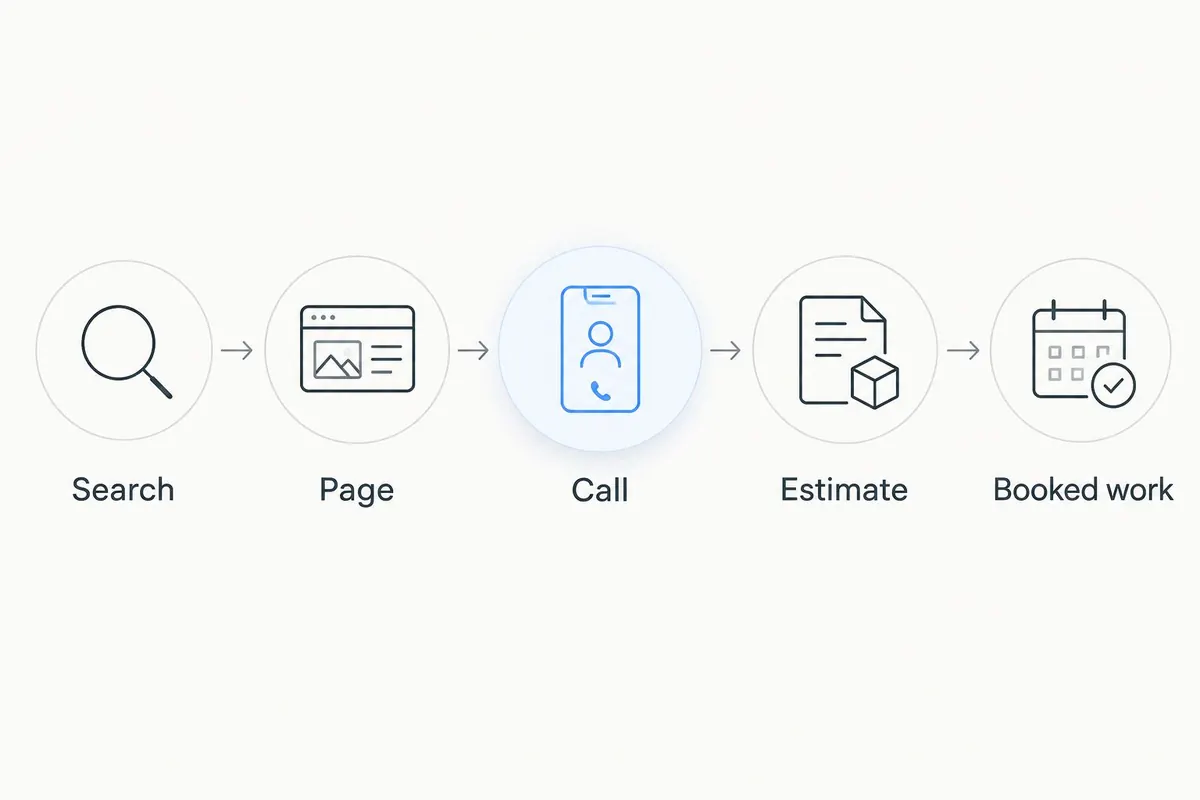
Wherever leads keep dying, fix that step first. For more on measuring this way, see how to judge marketing by booked jobs.
Can you run SEO and paid ads together?
Yes, and once the basics are in place, you should. Ads fill the calendar now while SEO and your Google Business Profile build the calls you won't have to pay for later. As organic calls grow, you get more room to decide how hard to push ads.
What doesn't work is two vendors sending mixed messages about the same service. Agree on target jobs, area, landing pages and call tracking before launch.
How we sequence it at Atlanta Pro Network
Our view on order is simple. Reviews, reactivation and speed-to-lead automations create early traction, because they stop the leads you already get from slipping. Google and Meta ads can book jobs in the first one to two weeks for clients who need work on the calendar. SEO and the Google Business Profile compound over months, so the sooner they start, the better. Every call is tracked to its source, so you can see which channel booked which job.
Our published packages are built around that sequence:
- Starter ($2,700 build, then $900/mo): website, Google Business Profile plus 60 listings, a review campaign, a CRM with automations so no missed call goes unanswered, and monthly SEO and reactivation. A good fit when you want the foundation and the slow lever first.
- Scale ($5,100 build, then $2,950/mo): an 8-page site built to rank for every service, map pack optimization, managed ads on Google or Meta, social media, and advanced automations and reviews. This is where SEO vs ads stops being a choice.
- Enterprise ($11,400 build, then $8,550/mo): everything in Scale plus video and photo shoots, a wrapped truck, ads on two platforms, email marketing and monthly consulting.
All of them run month to month after the build. We guarantee execution and communication, not a number of leads, and we'll set realistic targets for your trade, area and budget.
If you're trying to decide where your next dollar goes, book a free 20-minute call. Bring the services you want more of, the towns you want to work in and what happens today when the phone rings.
FAQ
Which is faster for contractors, SEO or paid ads?
Paid ads. Google and Meta ads can book jobs in the first one to two weeks. SEO and Google Business Profile work compound over months.
What's the fastest way to get more jobs without new traffic?
Catch the calls you already get. Missed-call text-back, quick follow-up on estimates, review requests and reaching out to past customers usually move first.
