 Atlanta Pro Network

Yes, most established plumbing companies should replace shared plumbing leads over time, but not in one cut. Services like Angi, HomeAdvisor and Thumbtack sell the same request to several plumbers, so you are paying to race your competitors to a homeowner who is already comparing quotes. Leads that come from your own website, Google profile and reviews belong to you. The smart move is to build those owned channels first, then phase the shared services down as the new channels prove they can carry the schedule.
TL;DR
- Shared lead services sell one homeowner's request to several plumbers. Leads from your own marketing are yours alone.
- Don't cancel a shared service that still books good work until an owned channel is producing jobs to replace it.
- Judge every source the same way: booked jobs and what each job leaves after acquisition cost.
- Fix call handling first. A missed call wastes an owned lead just as badly as a shared one.
What you are actually buying from a shared lead service
A shared lead is a homeowner's request that the platform passes to more than one contractor. When a water heater fails in a Marietta basement and the homeowner fills out a form, that request may reach you and several other plumbers at roughly the same time. Whoever calls back first, and whoever sounds most trustworthy in that first minute, usually wins.
That model has real uses. It can fill gaps when your own marketing is thin, and it costs nothing to set up. But look at what you are paying for:
- A race, not a customer. You are buying a chance to compete, not a booked job.
- Rented visibility. The homeowner found the platform, not you. When you stop paying, the flow stops and you keep nothing.
- No compounding. Each lead is a one-time purchase. It does not build your reviews, your search presence or your list of past customers in a way you control.
Compare that with a call that comes through your own website or Google Business Profile. That homeowner may still call another plumber, but they found your business, read your reviews and dialed your number. And every job you finish from that call can feed a review, a photo for your site and a customer you can reach again for the next water heater or repipe.
Shared leads vs owned channels, side by side
| Route | What you pay for | Who else gets the lead | What you keep when you stop |
|---|---|---|---|
| Shared lead services (Angi, HomeAdvisor, Thumbtack) | Each request or placement | Several competing plumbers | Nothing beyond the jobs you won |
| Your Google Business Profile and website | Setup and ongoing work | Nobody, it comes to you | Your listing, pages, reviews and rankings |
| Google or Meta ads to your own site | Clicks or impressions | Nobody, it comes to you | Your site, call data and customer list |
| Reviews and past-customer reactivation | Systems and follow-up | Nobody | A growing base of repeat and referral work |
Ads deserve a note. They also cost money per click, but the caller lands on your page and calls your number. Nobody else is handed that request. That is the line that matters: who owns the lead once it exists.
Judge each source by the job, not the lead count
Before you cut or keep anything, run every source through the same short check. Use it for shared leads, website calls, Google profile calls and ad calls alike, so you are comparing invoices, not sales pitches.
- Source. Record where each inquiry came from. If you don't know, mark it unknown rather than guessing.
- Fit. Was it a service you want, in an area you cover? A drain call from outside your territory is a fit problem, not a dispatcher problem.
- Booking. Did it become a booked job, an estimate, or nothing? Keep estimates separate from booked work.
- Job value. What did the finished job leave after labor, materials and the cost of getting the lead?
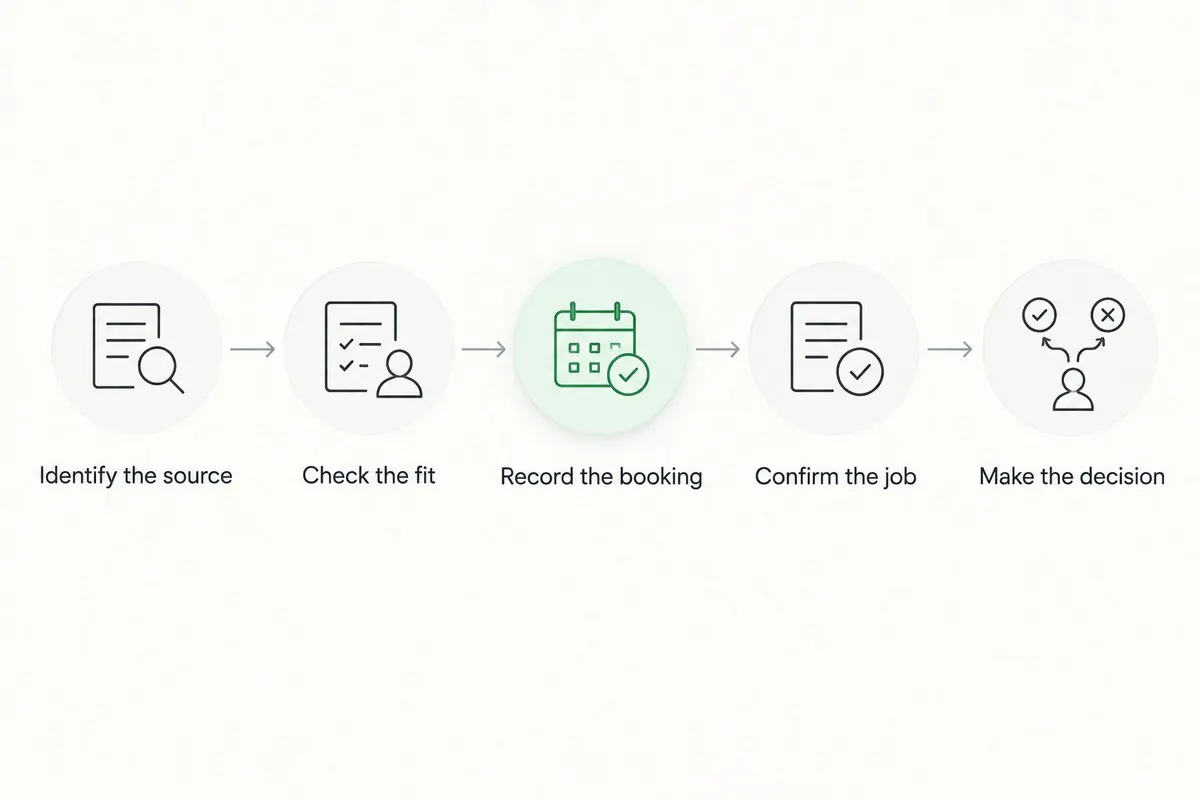
Shared leads often look cheaper per lead and more expensive per booked job, because you lose a share of them to whoever called first. Count the handling time too: callbacks, estimates for work you never wanted, homeowners who already hired someone by the time you reach them. If you want a fuller method for this, we wrote about judging marketing by booked jobs.
When a shared service should stay for now
Keep a shared lead service, at least for a while, when:
- It still books work you want at a cost the job can carry.
- Your own channels are new and not yet producing enough calls to fill the gap.
- It covers a specific service or slow season where your owned marketing is thin.
The risk is dependence. If most of your schedule rests on a platform you don't control, a price change or a policy change can thin out your calendar fast. Keep it while it earns its place, and use the time to build the replacement.
When it should go
Cut or narrow a shared source when the job records say so, not after one bad week. Common signs:
- Requests keep landing outside the areas you serve, or for work you don't do.
- Most leads are already booked with someone else by the time you call.
- Booked jobs from the source no longer leave enough after the lead cost.
Before you blame the platform, check your side. Tighten its service and area settings where it allows that. And make sure good callers are not reaching voicemail. If your office misses calls, changing lead sources will not fix it.
How to replace shared plumbing leads without empty days
The goal is to replace shared plumbing leads gradually, with each owned channel taking over work before you turn the shared one down.
1. Get the phone right first
Every channel, shared or owned, fails if calls go unanswered. Set up missed-call text-back so a homeowner who hits voicemail gets an automatic text and stays in conversation with you instead of calling the next plumber. Add automated follow-up for open estimates so nothing depends on someone remembering. Your team still takes the call and sells the job, but the system catches what slips through.
2. Build the owned channels in order of speed
- Fastest: Google or Meta ads pointed at service pages for the work you want (water heaters, repipes, drain and sewer work). Ads can start booking jobs within the first week or two.
- Early traction: Review requests after every completed job, and reactivation messages to past customers who haven't heard from you in a while. Your old customer list is the cheapest owned lead source you have.
- Compounding: Your Google Business Profile and website. These build over months, with some improvements showing in weeks. Our plumber SEO guide for emergency service companies covers this side in detail.
3. Turn down the shared service in steps
Once an owned channel is booking a steady share of a service, reduce shared-lead spend on that service or area. Watch the schedule for a few weeks. If it holds, step down again. If it dips, you have the data to see why before you cut further. There is no universal cancellation date. Your crew capacity and booked jobs set the pace.
4. Aim at the work you actually want
Shared platforms send what homeowners request. Your own marketing can be pointed. Intown neighborhoods like Decatur and Brookhaven have plenty of older homes where repipes and water heater replacements come up. Build pages and ads around the jobs and areas you want more of, not every plumbing search in Metro Atlanta.
Where Atlanta Pro Network fits
We build the owned side of this for Metro Atlanta plumbers: the website and service pages, your Google Business Profile and map pack work, managed Google or Meta ads, and the CRM automations behind them. That includes missed-call text-back, review requests and reactivation campaigns so the leads you generate actually turn into booked work.
Every lead we generate is yours. We never resell it to another plumber. We also work with one contractor per trade in each market, so we'll never take on your competitor. You can see how this works for plumbing companies on our plumbing marketing page.
A few things we say plainly. We guarantee execution and communication, not lead numbers, and we set realistic targets based on your trade, area and budget. Our packages are published, and after the build everything runs month to month with no 12-month contract. Your site, your domain, your content: we build it, you own it. That matters here, because the whole point of leaving shared leads is to own what you pay for.
If you want to map out which shared services to keep, which to phase down and what to build first, book a free 20-minute call. Bring a recent stretch of leads with their outcomes, and we'll look at it together.
FAQ
Should I cancel Angi or HomeAdvisor before hiring an agency?
No. Keep any shared service that still books worthwhile work until an owned channel is producing jobs to replace it. Then phase it down in steps.
Are calls from my own website exclusive?
The lead is yours. Nobody sold it to another plumber. The homeowner can still shop around, but they found your business and your reviews, not a list of competitors.
What's the first owned channel to build?
Usually call handling plus ads for the services you want, because ads can book jobs quickly. Reviews and reactivation add early traction, while SEO and your Google profile build over months.
What should I track to compare sources?
Source, service, location, whether it booked, and what the finished job left after the lead cost. Keep estimates separate from booked jobs.
