 Atlanta Pro Network

Good storm roofing marketing is mostly decided before the storm. In Metro Atlanta, spring and summer bring hail and severe thunderstorms, and when one rolls through Cobb or North Fulton, every roofer's phone starts ringing the same afternoon. The roofers who come out ahead are the ones who already agreed with their agency on where to advertise, how many inspections they can handle, what the ads are allowed to say and when to turn spending down.
TL;DR
- Write the storm plan in the off-season: service areas, accepted jobs, inspection capacity and who approves campaign changes.
- Never promise that insurance will pay or that a claim will be approved. Offer an inspection, not an outcome.
- Set up call handling and missed-call text-back before you raise ad spend.
- Agree on the slowdown rule first: what limit triggers it and who makes the change.
Why Georgia storms need a written plan
Hail and thunderstorm season in Georgia is not a single event. Storms can hit one part of the metro hard and miss the next county entirely, sometimes several times between spring and late summer. A hailstorm that damages roofs in Marietta and East Cobb may leave Johns Creek untouched, and the next one may do the opposite.
That pattern creates two problems for roofers. First, demand shows up suddenly and locally, so campaigns need to shift to the right areas fast. Second, homeowners in a hit neighborhood get flooded with door knockers, flyers and ads, so trust becomes the deciding factor. A rushed campaign with vague promises makes you look like everyone else on the street that week.
A written plan solves both. Your agency can move quickly because the decisions are already made, and your messaging stays honest because nobody is writing ad copy in a panic.
The storm roofing marketing checklist to give your agency
Set the boundaries
Name the cities, counties and neighborhoods you will actually send a crew to after a storm. Use your real limits, not a big circle around Atlanta drawn because it looks like more opportunity. If you cover Cobb and North Fulton but not Henry or Douglas, say so.
List the work you take: inspections, repairs, full replacements, emergency tarping. List what you don't take, too, such as certain property types or commercial roofs. An unsuitable call still pulls someone away from a homeowner you can help.
Separate inspection capacity from production capacity
Your agency needs to know how many inspection slots you can open, not a vague instruction to keep the leads coming. Keep that separate from production. An open inspection appointment does not mean you can start a replacement next week, and your website should not blur the two.
Decide who updates that capacity during a storm and how the update reaches whoever manages campaigns. A shared calendar or a single text thread is fine, as long as it is actually used.
Write honest storm messaging now
Give your agency approved language about your storm services, service area and next steps. The page should explain exactly what happens after someone reaches out: a callback, an inspection, then a written assessment.
Do not promise that insurance will pay, that a claim will be approved, or that a roof will be replaced at no cost. You cannot know any of that from an ad, and making those promises puts your reputation at risk. Offer what you can actually deliver: a professional inspection, documentation of what you find, and a clear explanation of the homeowner's options. If you help homeowners through the claims process, describe that help accurately without implying a result.
Also avoid prewriting claims that a named neighborhood has roof damage, or implying every homeowner in an area needs a new roof. Describe the service. Let the inspection decide the next step.
Prepare proof before you need it
Homeowners after a storm are deciding who to let on their roof. Real project photos, before-and-after shots from past storm work, and honest reviews from customers in nearby areas do more than any headline. Collect and approve them in the off-season so they are ready to drop into pages and ads.
This is where steady content pays off. A monthly shoot day that films real inspections, tear-offs and finished roofs gives you a library of storm-ready proof long before the next hailstorm.
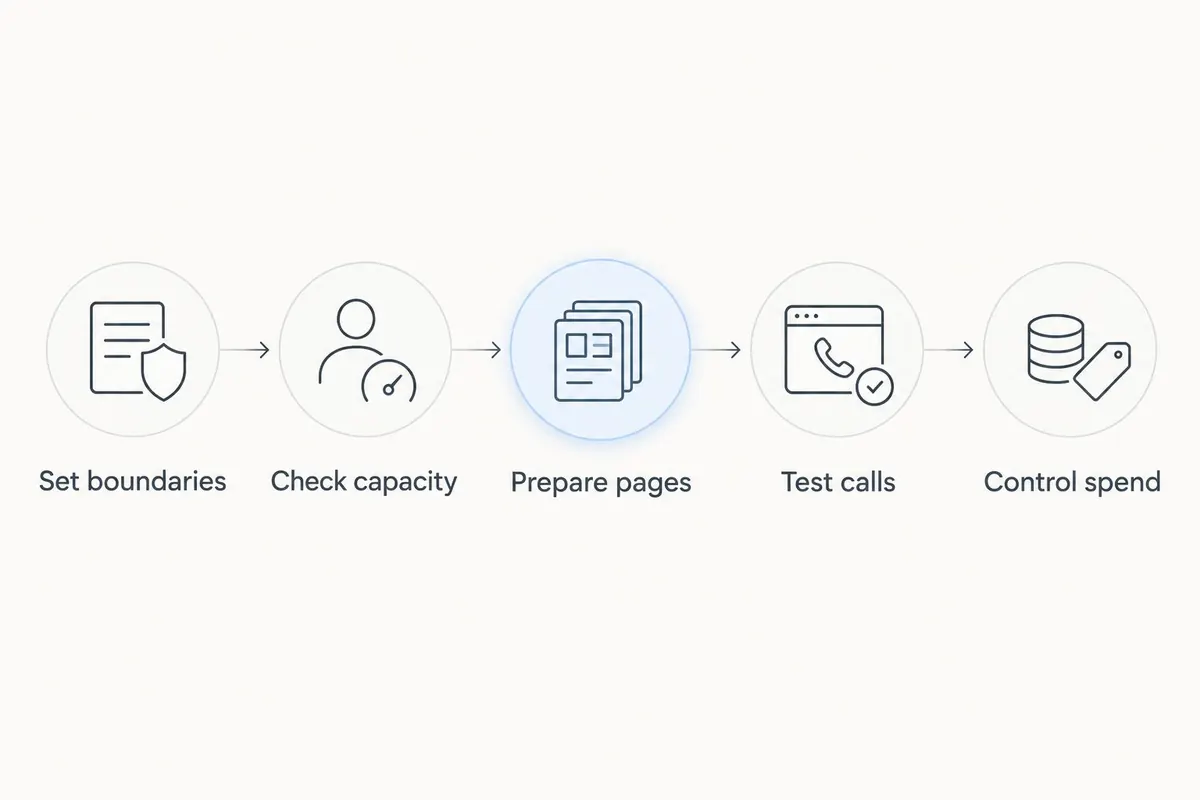
Test the phone path
Open your storm page on a phone, tap the call button, submit the form and confirm the right person gets it. Then test what happens when nobody answers.
Storm days are exactly when calls get missed: crews are on roofs, the office is buried and the owner is driving between inspections. Missed-call text-back sends an automatic text to anyone who reaches voicemail, so the homeowner stays in conversation with you instead of calling the next roofer on the list. CRM automations can confirm inspection times and follow up on open estimates so nothing depends on someone remembering at the end of a long day. Your team still runs the inspection and sells the job, but the system keeps leads from slipping.
Control the spend
Name the person who can approve campaign changes and the person who can stop them. Then write the slowdown rule: when inspection slots are full, or callbacks fall behind, the agency narrows the service area, narrows the advertised service, or pauses the campaign.
If your agency can explain how to turn advertising up but not when to turn it down, the plan isn't ready.
Storm response ads vs ongoing roofing marketing
Storm campaigns and your regular marketing do different jobs. Keep them separate so a homeowner with a fresh leak doesn't land on a page about upgrading to architectural shingles.
| Approach | Best for | What the message should do | What to manage |
|---|---|---|---|
| Storm response ads | Requests right after hail or wind damage | State the service, the area and the next step (an inspection) | Current capacity and someone answering calls |
| Ongoing roofing marketing | Planned repairs and replacements | Explain your work, show proof, make contact easy | Should keep running in areas the storm missed |
Google and Meta ads are the fastest lever here because they can be pointed at specific areas and switched on or off quickly. SEO and your Google Business Profile do the slower work of making sure you are already visible when homeowners search, storm or no storm. If you are weighing where to put budget first, we compared the two in contractor SEO or paid ads: which should you fund first.
What your office should report back
During a storm push, send your agency outcomes, not just "the calls are good" or "the calls are bad." For each request, capture:
- Where the work is.
- What the homeowner asked for.
- Whether someone spoke with them.
- Whether an inspection was booked.
- Whether the inspection became a signed job.
- Why it stopped, if it did.
"Outside our area," "no inspection slot," "missed call" and "homeowner went with someone else" are different problems with different fixes. When calls are tracked to their source, your agency can see which areas and ads are producing signed jobs and shift spend toward them while the storm demand lasts.
After the storm: don't let the leads go cold
Storm demand fades, but the homeowners don't disappear. Some got an inspection and decided to wait. Some got a repair and will need a replacement later. Some neighbors watched your crew work.
Use that. Ask every finished customer for a review while the experience is fresh. Follow up with homeowners who had an inspection but didn't sign. When the next storm hits the same area, reach back out to past customers and inspection contacts first. Review requests and reactivation turn one storm's work into the next season's pipeline.
How we help Atlanta roofers prepare
We build storm-ready marketing for Metro Atlanta roofing companies: area-targeted Google and Meta ads that can book jobs in the first week or two, a website and Google Business Profile built to rank for your services, monthly video and photo shoots that capture real storm work, and the CRM automations behind it all, including missed-call text-back, review requests and reactivation. You can see the full picture on our roofing marketing page.
We work with one contractor per trade in each market, so we'll never take on your competitor. The territory is agreed in writing upfront, based on where you actually want to win work. We guarantee execution and communication, not lead numbers, and after the build everything runs month to month.
If you want your storm plan written before the next season instead of during it, book a free 20-minute call. Bring your service areas, inspection capacity and current phone setup.
FAQ
What should I give my agency before storm season?
Your service boundaries, accepted job types, inspection capacity, approved messaging and call-handling process. Name who approves campaign changes and what triggers a slowdown.
Can a roofing ad say insurance will pay for a new roof?
No. Don't promise insurance payment or claim approval. Offer an inspection and an honest assessment, and describe any claims help you provide without implying a result.
Should I pause ads when inspections fill up?
Narrow or pause campaigns that promote appointments you can't handle. Keep running in services and areas that still have capacity.
How fast can storm ads start producing calls?
Google and Meta ads can book jobs within the first one to two weeks of launching. That speed only helps if your phone handling and inspection capacity are ready.
